- Heart & Soil Newsletter
- Posts
- Growing Mondays: Complex and complicated problems
Growing Mondays: Complex and complicated problems
Break complex problems down into tiny parts.

Jo Hunter Adams
January 19, 2026

Hi! I'm Jo, writing from Heart & Soil homestead, a 1-acre homestead in the Far South of Cape Town, South Africa. Every week I share inspiration and education for your growing journey. Thanks so much for reading!
Welcome to Growing Mondays, where I talk about growing- vegetables, fruits, animals and, well, people.
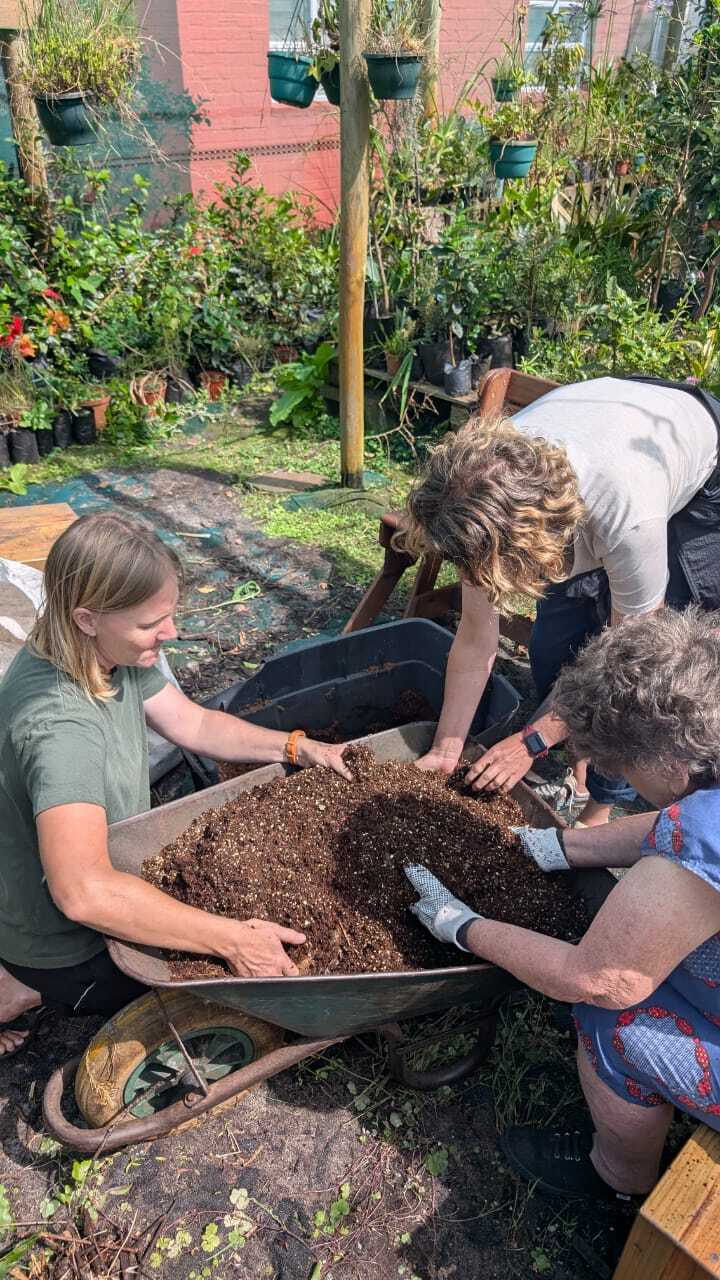
Mixing seedling mix with our lovely volunteers: towards the goal of continuous supply for our community of heirloom seedlings from locally saved seed, one tray at a time.
Growing, eating well, and being healthy is an infinitely complex problem that can only ever be lived out, never solved. But maybe they can be broken down into very small steps in each of our communities.
The South African Human Rights Commission has recently called for an inquiry into food security, and I’ve been mulling over whether there is something helpful that we, as Heart & Soil Agroecology Hub and as food scholars, could submit. My friend and researcher Donna and I have been emailing back and forth to generate some thoughts. I’d also welcome your thoughts via email if you have insights to share.
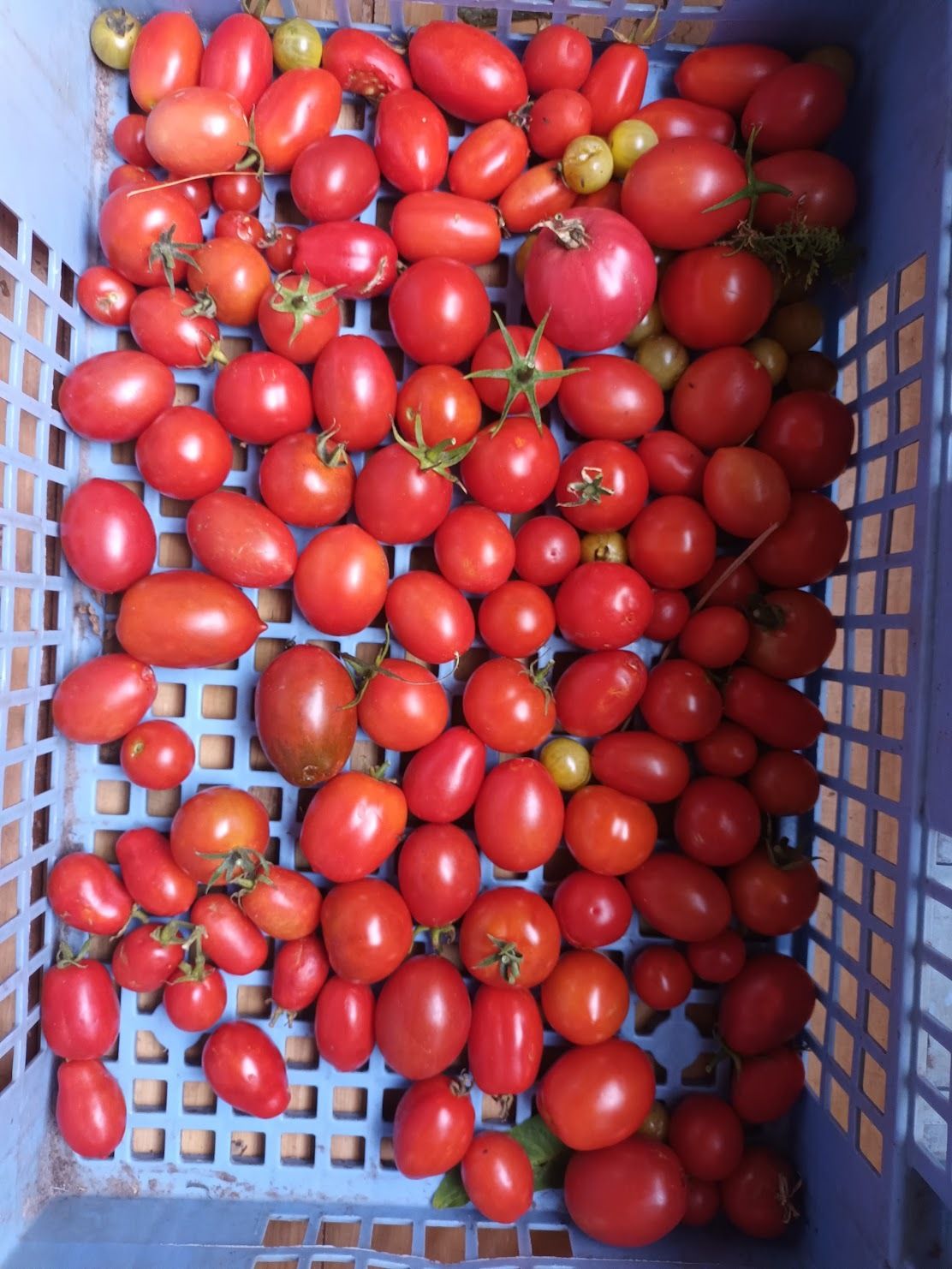
Our tomato harvest has been poor, but breaking down the challenge has helped me figure out an equally healthy set of options for 2026: 1) planting a second crop of tomatoes 2) harvesting what we have regularly and canning passata in smaller batches than usual 3) planning for other veg to take the place of passata where necessary. E.g. we’re preserving more pesto.
I thought one way to conceptualise food in South Africa is in terms of complicated and complex problems. This framing might also be helpful for you as you grow, harvest, eat, and generally seek to be healthy and happy.
A complicated problem is one that ultimately has an answer. How to build an aeroplane. Difficult, but knowable.
A complex problem has too many variables to ever be knowable. For example, a marriage will never be “solved.”
Food in our country— from agriculture to the way food behaves in our body— is perhaps treated as a complicated problem rather than a complex one. Something that can be solved in a long series of steps, or a unified top-down policy approach. Yet each step creates a set of infinite variables that ripple out.
I wonder if the collective journey of growing-eating-health has to be continuously lived out, rather than solved. And perhaps policy needs to support that continuous evolution.

Donna also helped me solve the problem of goats milk yoghurt. Just keep making it…
In the living out of complex problems, there are key points of leverage. If food security as a whole is seen as a grand problem to be solved rather than a collective journey to be lived, it is difficult to make progress. If we break the problem down into tiny parts, the problem begins to be untangled. Rather than food security for millions of people, what brings one dignified job, or one set of healthy meals?
If those tiny parts overlap with key points of leverage, then perhaps we can gain momentum. So perhaps what is needed is to identify those tiny parts of a much larger problem.

The soapmaking journey has been one batch of soap at a time.
Maybe there are a million small actions, in a million places, that can help us progress. One job created, or one spinach grown for our community, or one small food sharing project at a time.
I don’t mean that there shouldn’t be good national policy in place. But we don’t need to wait for it to be discovered, or uncovered, because perhaps it is primarily lived out. We can meet our national policymakers from the ground up, as they descend with policy from above. Every day we can identify tiny habits to grow things well: we can grow good food, we can share good things to eat, we can explore ways that that nourishment translates into being healthy and happy. And then we can share those with our community. And perhaps those tiny steps can eventually be mirrored in policy.
I’d love to hear your thoughts on the tiny habits that help you grow, eat, or work towards health, and how you’re sharing those with your community.
Workshops
1 Feb 1-2:30 Cheesemaking |
If you are enjoying our newsletter, consider forwarding on to someone in your community. If you received this from a friend, you can sign up here
Reply